Posts

Showing posts with the label Photography Tips

Five Viewpoints for Photographing the Babcock Grist Mill
Image
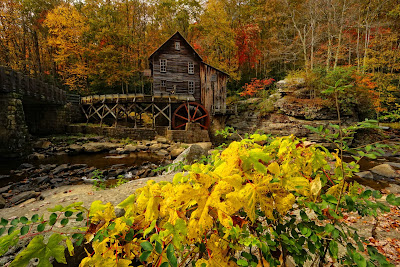
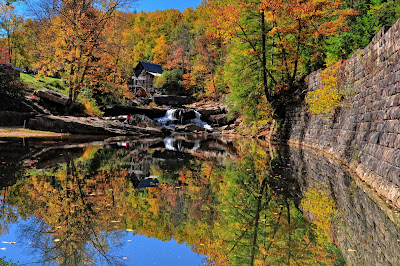
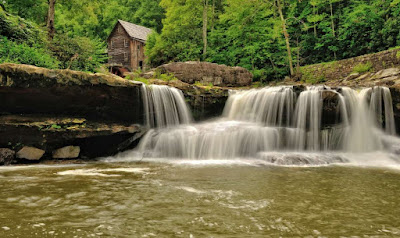
The Glade Creek Grist Mill at Babcock State Park is one of the most photographed sights in West Virginia drawing more than 200,000 people every year. You�ll find pictures of the mill at Babcock on calendars, postcards, magazines, and travel brochures. Most of the visitors to Babcock have a camera in their hands wanting to take home their own photos of this West Virginia icon. In photographing the Babcock Mill and the Glade Creek Falls for the last 15 years, I�ve learned that many points of view (pov) can be found to capture the falls and the mill, but generally most people settle for two traditional views. View from the Rocks at the End of Stairs For their first shot of the falls and the mill, most people traditionally take the stairs behind the lodge down to the pond and shoot from the rocks at the end of the stairs. From this pov both the falls and mill are close and produce good composition. View from Sewell Road Opposite the Dam Another traditional point of view is to walk down Sew...
The Art of Wildflower Photography:

Image
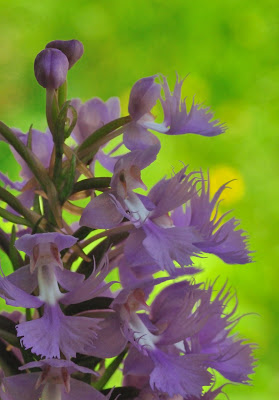
Since spring is here, some tips on the art of wildflower photography might be appropriate. Let me begin by saying that I am only expressing my opinions about the subject. In my view, the qualities of a good wildflower photograph are those that: exalt the beauty, uniqueness, and character of a wildflower as seen and felt by the photographer in its natural setting. Delving deeper into the art of wildflower photography, I believe a good image employs the wildflower as a means of evoking emotions, provoking thoughts, and inviting the observer to explore the nature of self and the world. In this blog, I would like to share eight images that illustrate my approach to the art of wildflower photography. Purple Fringed Orchid Focus on the unique:   This image of a purple-fringed orchid highlights the intricate fringes of the orchid. By taking a profile view of the flower head and by eliminating any background detail that would distract or obscure the blossom, the fine structure of the fring...

Ten Tips on How to Photograph Waterfalls

Image
As a photographer, I am frequently asked this question: �How do you get that �flowing water� effect in waterfalls?� It�s not difficult if you have the right equipment and a little �know-how.� Here are ten basic tips to help you take waterfall photographs. Slow Down the Shutter  The key to good waterfall photography is to slow down the shutter speed. I shoot most waterfalls at 1/4 to 2 seconds. At these shutter speeds, you�ll get the flowing water or motion blur effect. To capture swirls or eddies, you�ll have to go slower, say 5, 10, even 60 seconds depending on the speed of the water. On the other hands, to highlight flow details and texture, I shoot at 1/8 to 1/15 second. But there�s a catch to these slow shutter speeds. Brush Creek Falls Get a Neutral Density Filter In normal daylight, when you manually slow down your shutter for waterfall photography, the image will over expose no matter how much you reduce the aperture or lens opening. That�s just the way cameras are made. But...

Seven Ways to Capture Brilliant Color in Fall Photography

Image
How do you get good autumn photographs even if the fall foliage lacks brilliance? I was asking this question all day at one of my (and everyone else�s) favorite places to shoot fall photographs�Babcock State Park, Fayette County, WV. Due to an extremely hot and dry summer, the leaf color change has been muted somewhat and delayed by about a week. Even so, here are seven ways to photograph fall scenes to bring out the very best in autumn color.  Bright Foreground Bright Foreground  One way to spruce up the color is to include bright foreground foliage. An overhanging branch or a small shrub work well in this instance. As a bonus, these foreground elements add depth to the work and can act as natural frames.  Back-lighting Use Back Light Nothing lights up leaves like back-lighting, which is simply having the prime light source behind or in back of the subject. In outdoor photography, the sun is the primary light source, so to get autumn leaves to shine for you simply align ...

Fall Colors in Southern West Virginia

Image
In chasing fall colors in West Virginia, you generally move from high elevation to low elevation and from north to south. By mid-October the leaves are beginning to change in southern West Virginia. Here are some suggested locales to catch the fall colors. Babcock State Park  Babcock State Park in Fayette County is well known for gorgeous autumn displays, but timing is crucial. Usually I find mid-October, around the 15th to the 18th, the most resplendent time. But this year the color change has been delayed a week to 10 days. I�m guessing that peak at Babcock might be this coming weekend Oct 21-23rd.  Babcock State Park Since photographers flock to the Glade Creek Grist Mill, finding a view unobstructed by other photographers is a challenge. Not seeing many photographers on the shoulder of the dam across Glade Creek, I have found that spot a good place to take advantage of reflections off the pond below the lodge.  Babcock State Park For ideas on other places at Babcock t...

Autumn Colors at Babcock: Places beyond the Mill

Image
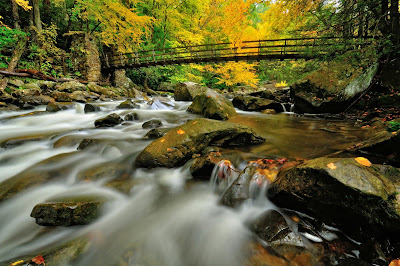
Although the grist mill at Babcock is a photo favorite, there are plenty of places beyond the mill that look great in autumn colors. Swinging Bridge at Babcock The Swinging Bridge The swinging bridge over Glade Creek is a great place to capture fall colors at Babcock. While other photographers are vying for position at the mill, walk down the road by the mill to Cabin #7. Then take the stairs down to the cabin and walk around to the back of the cabin. You�ll find a path leading down to the swinging bridge. Glade Creek really shows off at this point with plenty of cascades and color. With the bridge as a backdrop, you�ll find plenty of compelling compositions. Isolations and reflections off the creek will keep you busy, too.  Swinging Bridge at Babcock Glade Creek Reflections Mann�s Creek Glade isn�t the only creek at Babcock. Mann�s Creek flows through the park, too, and is photogenic as well. I�ve found some good color and compositions at the bridge crossing the creek near the Nar...

Three Tips for Better Fall Photographs

Image
Though digital cameras are technologically impressive, none of them can capture a scene as well as the human eye and mind working together. Aware of the limitations of their technology, camera manufacturers have added features to compensate for them. In this article, I offer three tips on how to use these features to improve the photography of the brilliant colors of fall. To illustrate my tips I will refer to a photograph I took in the Fall of 2012 at the New River Drys.    Briery Knob Tip #1: Experiment with the White Balance.  White balance settings on your camera compensate for the kind of light illuminating the scene you are shooting. As evidenced by the color of the sky, a sunny day sheds a lot of blue light. Your eye working with your mind automatically tones down the excess of blue light in such a way that a white object will still appear white to the eye. But a camera does not do this. It simply records without bias the colors of light hitting its sensor.  E...

For Better Scenic Photographs, Frame Your Photo Naturally

Image
You can also polish the look of your outdoor photographs with a simple composition technique called �framing.� Just as paintings and photographs are typically surrounded by wood or metal frames, a photographic image can be taken with natural borders or frames. For example, the image of an inlet at Summit Lake (a great fishing and hiking spot about 10 miles east of Richwood, WV) is encircled on the top and left side by an arch of autumn leaves that form a natural frame. Likewise shoots of green plants border the bottom of the image. These two borders envelope much of the image forming a natural frame.  Babcock Grist Mill I don�t know exactly why the eye is pleased by framing, but it generally is. I do know that natural frames seem to complete the image. Framing also draws attention to the subject of your image. The framing in the example photograph gently steers the eye across the image. Moving from left to right, the eye naturally drifts within the borders of the frames following t...